Polyglot AI Agents: WebAssembly Meets the Java Virtual Machine (JVM)
Leverage the JVM's polyglot capabilities to create a self-contained, enterprise-optimized server-side blueprint that combines the performance benefits of WebAssembly with the reliability and maturity of Java's ecosystem.



Following up on Baris Guler's excellent exploration of browser-native AI agents using WebLLM + WASM + WebWorkers, we're excited to present a complementary approach that leverages the Java Virtual Machine's unique polyglot capabilities and enterprise-grade infrastructure.
Introduction
In previous posts, Davide Eynard demonstrated how to run agentic frameworks in the browser, while Baris Guler showed how to extend them with in-browser inference and support for multiple programming languages. In this post, we leverage the JVM's polyglot capabilities to create a self-contained, enterprise-optimized server-side blueprint that combines the performance benefits of WebAssembly with the reliability and maturity of Java's ecosystem.
Why the JVM for AI Agents?
While the browser-based approach has its advantages like privacy, offline capability, and user control, enterprise environments often require different characteristics: centralized management, resource optimization, security controls, and integration with existing infrastructure. The JVM is uniquely positioned to bridge this gap, offering several compelling advantages for AI agent deployment:
Enterprise-Grade Infrastructure: Built-in monitoring, profiling, debugging tools, and enterprise security features that are battle-tested in production environments.
Self-Contained Deployment: Everything runs within JVM boundaries, no external dependencies, no complex toolchain management, just a single JAR file that contains all the AI capabilities.
Memory & Resource Efficiency: The JVM's garbage collector manages memory for all languages uniformly. By running agents within a single process, we reduce memory overhead and enable efficient resource utilization.
Polyglot Capabilities: By leveraging WebAssembly, agents written in multiple languages such as Rust, Go, Python, and JavaScript can run within a single JVM process. Each module is strictly sandboxed, allowing diverse agents to coexist safely without sharing memory.
Architecture: The JVM as a Polyglot AI Runtime
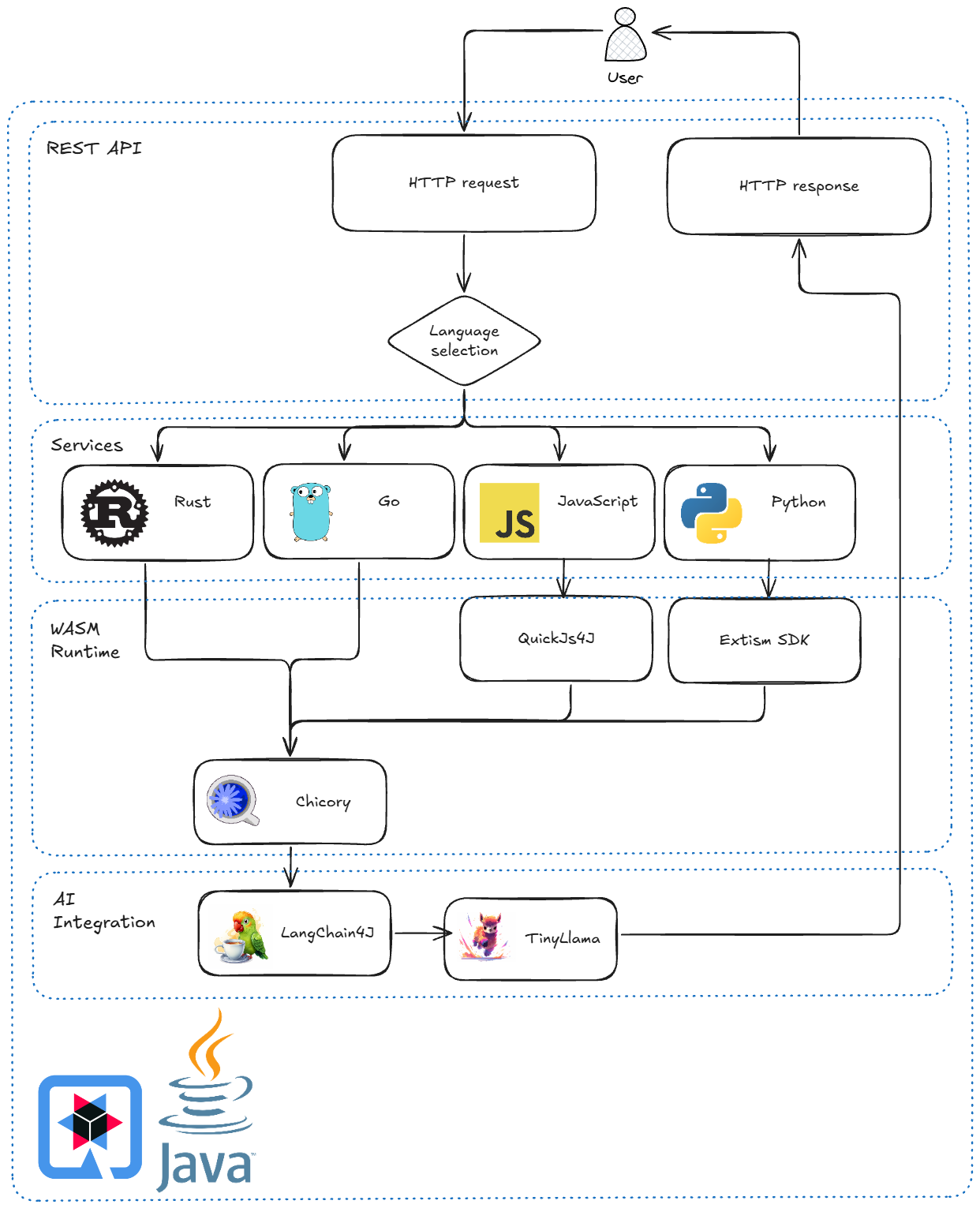
Our architecture demonstrates how the JVM can serve as a unified runtime for multi-language AI agents.
The system is organized into four distinct layers:
- REST API: Exposes an endpoint to handle HTTP requests and routing (in our example we provide path-based routing following a /hello/{language}/{lang}/{name} format).
- Services: Handles core logic by exposing a ChatService for LLM prompting, and dedicated services for each agent type. While we provide language-specific services (e.g. one for Rust, another for Go, and so on), the agents themselves are fully configurable via the REST API.
- WebAssembly Runtime: Core integration layer where language-specific modules are executed. The architecture supports three parallel integration paths:
- Chicory: Java WebAssembly runtime that executes Rust and Go Modules within the JVM.
- Quickjs4J: Handles JavaScript execution, bridging the JVM with the QuickJS engine.
- Extism: Manages Python(compiled with PyO3) execution using Extism’s Chicory SDK, providing a safe interface for running Python code alongside Java.
- AI Integration: Once the agent logic executes, the flow merges into LangChain4j as a Java integration framework, JLama (Java implementation of LLaMA) for model inference, and TinyLlama-1.1B as a lightweight model for efficient local processing.
Try It Yourself
Getting started is straightforward. You can clone the repo and run the blueprint locally:
# Clone the repository
git clone https://github.com/mozilla-ai/wasm-java-agents-blueprint.git
cd wasm-java-agents-blueprint

# Start the application in development mode
./mvnw quarkus:dev

# Test the polyglot agents
# 1. Rust Agent (English)
curl -X PUT "http://localhost:8080/hello/rust/en/Alice" \
     -H "Content-Type: text/plain" \
     --data "Tell me about yourself"

# 2. Go Agent (French)
curl -X PUT "http://localhost:8080/hello/go/fr/Bob" \
     -H "Content-Type: text/plain" \
     --data "What can you do?"

#3. Python Agent (German)
curl -X PUT "http://localhost:8080/hello/py/de/Charlie" \
     -H "Content-Type: text/plain" \
     --data "Explain your capabilities"

#4. JavaScript Agent (Spanish)
curl -X PUT "http://localhost:8080/hello/js/es/Diana" \
     -H "Content-Type: text/plain" \
     --data"How do you work?"
Enterprise Use-Cases & Future Roadmap
The JVM approach unlocks several immediate capabilities for enterprise-focused use cases:
Real-World Use Cases
Centralized AI Services: Deploy AI agents as microservices within your existing Java infrastructure, leveraging existing monitoring, security, and deployment tools.
Multi-Language AI Pipelines: Build complex AI workflows that support agent development in the optimal programming language. For example, write agents in Python for data processing and use Rust agents for performance-critical computation.
Security and Compliance: Leverage standard JVM security features and enterprise-grade access controls, ensuring that compliance requirements are met for sensitive AI applications.
Roadmap & Enhancements
Several architectural improvements could significantly enhance our JVM-based blueprint. The current implementation works well, but there's room for optimization and new capabilities:
Multi-Model Agent Orchestration: Enable agents to work together across languages, with Rust agents handling performance-critical tasks, Python agents managing data processing, and JavaScript agents providing dynamic behavior.
Performance Optimization: Add JVM-specific optimizations like GraalVM native compilation for reduced memory footprint and faster startup times, plus advanced garbage collection tuning for WASM workloads.
Deep Observability: Integrate with enterprise monitoring tools like Micrometer, Prometheus, and distributed tracing to provide comprehensive visibility into agent performance, token usage, and latency.
Dynamic Loading: Support for hot-swapping agent implementations without service restarts, enabling A/B testing and gradual rollouts of new agent capabilities.
Integration with Enterprise Middleware: Enhanced integration with message queues, event streams, and enterprise service buses for building complex AI workflows.
Conclusion
The JVM's polyglot capabilities, combined with WebAssembly and modern AI frameworks, offer a unique “best of both worlds” solution for enterprise AI. By leveraging WASI for secure WebAssembly execution and LangChain4j for AI integration, we can create self-contained, efficient, and scalable AI agent systems that integrate seamlessly with existing Java infrastructure.
The key insight is that the choice of runtime, whether this is browser or JVM, should be driven by the specific requirements of your use case:
- Choose the Browser (WebLLM +WASM) when privacy, zero-install user experience and offline capabilities are paramount.
- Choose the JVM (Java + WASM) when you need enterprise-grade observability, and seamless integration with existing backends.
The future of AI agent deployment isn't about picking a single winner, it’s about finding the right tool for the right job. By combining the JVM's mature ecosystem with the flexibility offered by WebAssembly, we now have a solid foundation for building the next generation of enterprise AI applications.
Links and Resources
This blueprint is built on top of several excellent open-source projects. Here are the key technologies and resources:
Technologies
- Quarkus - Modern, cloud-native Java framework with fast startup times
- LangChain4j - Java AI framework for LLM integration
- JLama - Java implementation of LLaMA for local inference
- Chicory - Pure Java WebAssembly runtime
- Extism Chicory SDK - Extism SDK for Chicory WebAssembly runtime
- Extism Python PDK - Python Plugin Development Kit for Extism
- QuickJS4j - JavaScript execution within the JVM
- TinyGo - Go compiler for WebAssembly
- PyO3 - Rust bindings for Python
Related Projects
- wasm-agents-blueprint - Original browser-based WASM agents blueprint
- wasm-browser-agents-blueprint - Browser-native AI agents with WebLLM + WASM + WebWorkers
- Mozilla.ai Blueprints Hub - Collection of AI agent blueprints and examples
This blueprint is part of Mozilla.ai's ongoing exploration of AI agent deployment patterns. Check out the wasm-java-agents-blueprint repository to try it yourself and contribute to the future of polyglot AI runtimes.